Good Neighbors Parliamentary Meet
The Korea Team Golden Hour had a parliamentary meet, visiting the National Assembly and accomplishing different activities to raise further awareness about climate change.
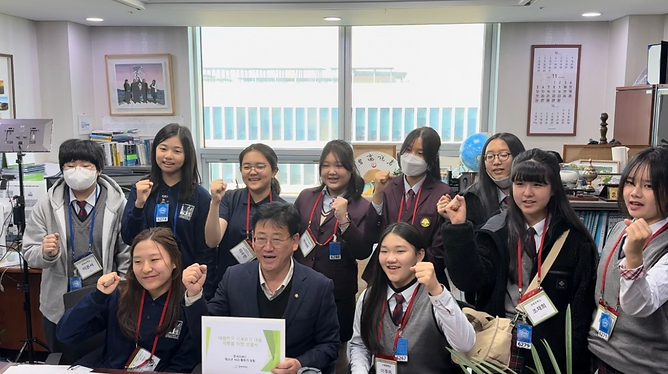
After having several continuous meetings of networking globally with other teams, the Korea Team Golden Hour was able to get an opportunity to visit the National Assembly and have a Parliamentary meeting on November 20th. Before visiting the National Assembly, the Korea Team met together to talk about the following plans (schedule) for the day as well as practice the placard activity that will be done in front of the National Assembly. After all of the practices and discussions, the Golden Hour team visited the National Assembly and met Kim Jung-Ho, the Chairman of the National Assembly Climate Crisis Special Committee (member of the National Assembly). During the meeting, students were able to introduce themselves and ask questions they had about climate change (the actions, what the government is doing, etc).
Eunice: “I believe that the climate crisis is a complex problem that cannot be solved by just one field, such as science or industry. I am curious as to whether there is an institutional plan in place for how various fields can work together to solve this climate crisis problem.”
With this question, Kim Jung-Ho chairman has responded that there is a Carbon Neutrality Committee under the Prime Minister and in the National Assembly there is a Special Committee on Climate Crisis of which he is the Chairman. He believes as well that everyone should work hard to solve the problem.
Soorin: “At what point did Korea begin to recognize the climate crisis and take action? Also, what was the first policy that was established?”
With this question, the chairman has answered that the response to climate change began at a national level by creating the Presidential Committee on Green Growth in 2009. In 2021, the Carbon Neutrality and Green Growth Commission was created and began building specific ways to reduce carbon neutrality in each field.
Alyssa: “Not only developed countries but also most countries around the world are reducing carbon emissions through energy policies tailored to each country's characteristics, such as using much renewable energy to overcome the climate crisis. What are some examples of countries we should learn from or keep an eye on?”
With this question, the chairman has stated that Germany can be an example. Germany completely closed driving in April 2022. Completely different from South Korea, however, stated that the renewable energy solar power and wind power generation ratio between onshore and offshore achieve 100% by 30 years. They focus on trying to focus on the rapid increase in the proportion of renewable energy.
Hearing the responses and replies from the chairman seemed to be very remarkable and thankful for having this amazing opportunity since the curiosity that students had was able to be solved. With the Q&A session, Alyssa Han was also able to deliver a proclamation that our Korea team has written based on their research and thoughts on climate action.
Overall, being able to hear, talk, and actually meet the representative Kim Jung-Ho and delivering speeches, asking questions, and hearing responses seem to be an unforgettable experience. Furthermore, students participated in the placard activity that they had been practicing in the morning. The placard activity is where there are several statements or phrases as a split word for each placard and the goal is to show fully as a whole by matching the time of changing the cards.
There were in total 6 statements created by the Hidden Figures team: “Help (Earth)!” “The climate crisis is permeating our daily lives and will soon overtake us.” “If you think the climate crisis is not your business, there is no tomorrow.” “Our youths can create a happy planet for you to live in together.” “We can create a change! We Connect, We Change!” Throughout the experience, the Korean team was very proud to think that they were able to contribute in some small way to overcoming the climate crisis by carrying out policy advocacy activities as youths and able to learn that solidarity and individuality among global citizens are necessary to solve the problem of responding to the climate crisis in the future.
This whole experience has been posted on social media and news articles. Please check them out on Good Neighbors YouTube, Instagram, Joongang article, and Donga News!